
Many CBD stores just survive, not thrive. CBD retail was a lucrative business in 2019, when the CBD boom occurred, and it still can be – but competition is fiercer, demand has fragmented across multiple product categories, and recent legal challenges might be making it harder for you to keep stocking the products your customers want.
So how do you drive more foot traffic for your CBD store and ultimately, keep your revenue growing?
One of the best ways is local search engine optimization (SEO). SEO helps you drive more foot traffic by making your store(s) visible in the exact place people go to find CBD and at the exact moment they’re doing so.
This place, of course, is Google search. When people need CBD, the look up “cbd near me” and click on Google’s Local Pack and regular organic results. Some also go to AI platforms. A great SEO strategy positions you for visibility across all of these surfaces.
Here’s the complete playbook we use to help CBD stores continue to thrive in 2026.
Why Is SEO So Impactful for CBD Stores?
If you run a CBD store, you’ve probably felt the ground shift under you over the last few years.
SEO isn’t just another marketing channel here – it’s one of the few reliable ways to drive customers that lets you adapt to the changing legal and market landscape of the CBD space.
The Demand Landscape Has Shifted
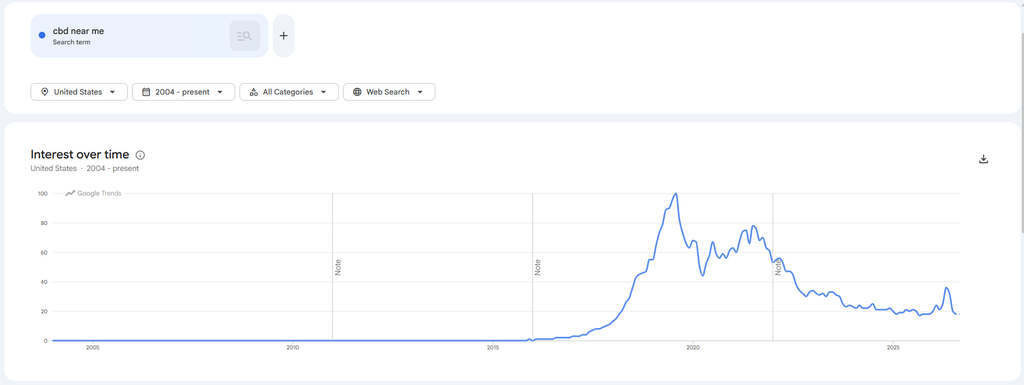
CBD surged in popularity around 2019 and has cooled considerably since (see first figure), but the broader hemp-derived product category hasn’t necessarily shrunk.
Instead, it’s shifted: delta 9 products, THCA products, and THC drinks have all exploded in popularity to replace (or in some cases, supplant) the demand for CBD.
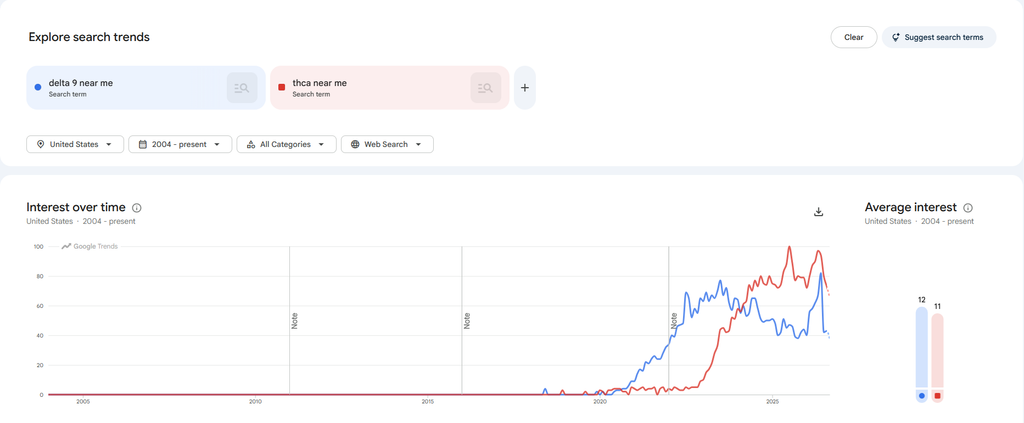
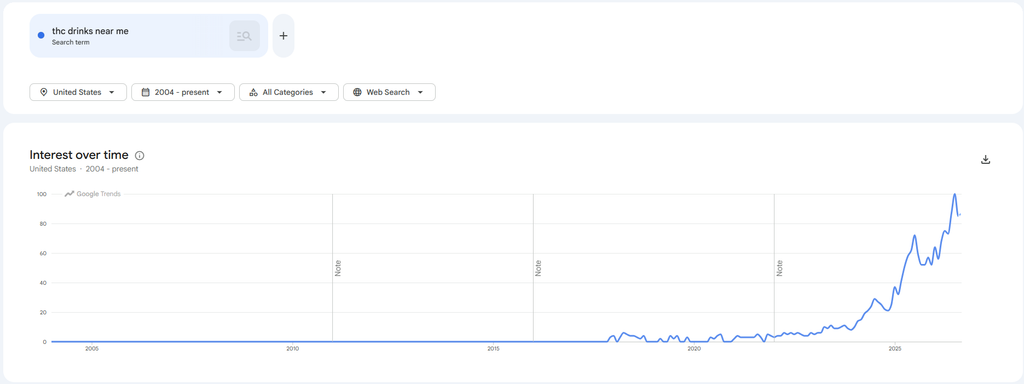
This has huge marketing implications. If you build your store’s identity around CBD and haven’t significantly evolved your products and marketing to cope with the new realities of the industry, you might be feeling some pullback.
But SEO can help remedy this shift and help you adopt to future shakeups. By building the on-page structure and off-site visibility to compete for these alternative-product keywords, you can become visible to the people searching for these trending products.
And as things change, you can adapt your SEO strategy to ensure you stay visible across the most popular product categories instead of being stuck riding a declining category downward.
In a dynamic, wild-west industry like hemp, SEO is a marketing channel worth betting on because it helps you stay relevant no matter what people are searching for.
Google Is Where People Find CBD, Delta-9, and THCA Products
As a CBD and hemp retailer, you run a specialty goods store. Unlike many consumer packaged goods (CPG) categories, CBD and hemp often isn’t stocked in big box stores, despite being a routine-based – rather than an occasion-based – products.
So, people can’t just add it to their Wal-Mart list. They have to find it on Google instead. They search “CBD near me,” “THCA near me,” and so on.
By investing in SEO, your CBD store can show up in Google’s Local Pack (which shows at the top of most local search result pages) for these keywords, which means you’re visible at the exact moment people want to buy.
Paid Ads Can Be Difficult to Run
Paid ads aren’t strictly impossible for CBD and hemp retailers the way they are for some categories, but they can be inconsistent, expensive, and prone to sudden account shutdowns.
Google and Facebook have maintained strict advertising bans on cannabis-adjacent and drug-paraphernalia-related products for over a decade, and platform enforcement has proven unpredictable even for compliant, legal businesses [2].
That volatility makes paid media a poor “1A” channel – the one thing your whole customer acquisition strategy depends on.
So, SEO is often the better option. You’re not subject to the same restrictions in organic search, and if you can rank, your business will be directly in front of a stream of in-market CBD customers.
CBD Has a High “Readability Index”
Compared to most CPG products, CBD and hemp products require far more buyer education. Nobody reads three in-depth guides before buying a soda, but for CBD and hemp products – which are used for wellness, can be psychoactive, and come with a legal gray area – most people need to do some research before they feel comfortable buying.
This education is one of the strengths of SEO as a marketing channel for your business: you can build a full-funnel content strategy that educates first and converts second, which is a far more durable approach than trying to force a transactional sale on the first visit.
SEO Strategy for CBD Stores
So, where do you need to show up in order to drive more foot traffic and orders from organic search? Here’s the breakdown.
Goals of Dispensary SEO
There are three key visibility goals your CBD store needs to achieve through SEO:
- Rank your Google Business Profile higher in the Local Pack for local transactional keywords.
- Rank your website in the regular search results for both local transactional keywords and informational keywords.
- Get your brand mentioned, cited, and linked to in AI search – Google AI Overviews, Google AI Mode, and ChatGPT are your three most important surfaces here.
How SEO Works
Now you know where your CBD brand needs to rank. Here’s how visibility across these surfaces works:
The Local Pack
Rankings in the Local Pack is governed by three factors:
- Proximity: Your address relative to the searcher, which you can’t easily change but should account for.
- Relevance: How well your business matches what someone’s searching for – best improved through content about your business and products.
- Prominence: How well-known you are, best improved through reviews, backlinks, and third-party mentions.
The more of all three your CBD store has, the better you’ll rank when someone searches “cbd near me.”
Regular Search Results
To rank in the regular blue-link search results, you have to account for two things:
- Search Intent: This has to do with how well your pages actually help the searcher accomplish their goals. Once you identify a keyword you want to rank for, you’ll need content that fulfills the goals people have when they type this term into Google.
- Website Authority: This is a general measure of how strong and trusted your overall site is, driven largely by backlinks, mentions, and relevant content. The important benchmark isn’t some absolute authority score – it’s simply having more authority than your direct competitors, which is often more achievable than it sounds.
So, if you meet search intent across the keywords you target and then build website authority to back it up, you’ll see improvements in your rankings.
AI Search Results
AI search results work a bit differently, and the rules are still being written by each platform.
However, there are two fairly reliable levers:
- Land mentions on the sources AI platforms are already citing – search a bottom-of-funnel prompt like “what’s the best dispensary in [your city],” see what gets cited, and pursue inclusion on those sources directly.
- Create your own “lookalike” sources similar to what’s already being cited, so AI platforms have a reason to start citing you instead. In general, everything else you do for SEO – content, authority building – also compounds your AI visibility over time.
You’ll need to deep-dive into the corpus of content AI is favoring, then get your brand included in that content while making more that’s similar to it.
1. Google Business Profile
Your Google Business Profile is ground zero when it comes to improving your CBD store’s Local Pack rankings.
Here are the four areas you need to focus the most:
Complete Your Profile
Fill out every field on your Google Business Profile – the more detail Google has, the more nuanced a query it can match you against, especially as AI search handles increasingly specific questions.
This sounds straightforward, but we regularly see stores that have neglected to fill out things like their parking information or business description.
Choose the Right Primary Category
If you’re selling any cannabis-derived product – CBD, THC, gummies, whatever the form – you have to select the Cannabis Store category in Google Business. Don’t choose “herbal medicine shop” or any sort of other category. Google knows CBD is part of the Cannabis Store category, so they’re much less likely to serve your profile if there isn’t a match with your profile.
Add Images and Videos
Lots of CBD shops post consistently on their Instagram and Facebook profiles, but neglect adding new media to their Google Business Profile entirely.
Google treats the addition of new photos and videos as a signal of how active you are locally, so regularly adding new media of your store can confer a ranking boost – on top of the obvious benefit of giving your customers a preview of what’s inside.
Connect Your Social Media Profiles
Adding your social profile links (Instagram, Facebook, etc.) to your Google Business Profile.
This gives Google an ongoing feed of information about your business – if you mention a specific product on a connected profile, Google will now know you offer that item and recommend your store when someone’s searching for that item nearby.
This is especially powerful for AI overviews and other AI search features in Google: your connected social media profiles can increase how often you’re mentioned as a result of this learning.
Implement a Google Review Acquisition System
Apart from simply completing your profile, the level you can pull that has the most influence on your Local Pack rankings is reviews – specifically, implementing a system to meaningfully outpace the rate at which your competitors get reviews.
Google values review velocity, volume, and quality (star rating), with velocity being the strongest signal that a business is currently a great option.
This means you can outrank a competing store if you can get reviews more quickly, even if they’ve been in business longer and have more total reviews.
This can be as easy as printing out a QR code that links to your Google Business Profile and asking every happy customer to scan it and leave you a review.
2. On-Page SEO & Content Development
Next is on-page SEO – the work you do optimizing and building your website’s pages. The goal here is to increase your relevance by having content that explains what you are (a CBD store), where you’re located (the city you’re in and the cities you serve), and the products you offer.
Homepage
Your homepage is often the first place Google and searchers look to confirm what you are and where you serve, so state that clearly and early.
If you’re a single-location store, put your main category and city in your H1, like “[City]’s CBD Store” or “CBD Store in [City], [State].” If much of your revenue now comes from THCA, delta 9, and other hemp-derived products, consider positioning around a broader term like “cannabis store” or “hemp dispensary.” That also aligns with the Cannabis Store category on your Google Business Profile. Choose the term that reflects what customers actually come in for, and use it consistently across your site and your profile.
If you have multiple locations, keep your homepage focused on your brand overall and let your location pages target specific city terms.
Either way, make sure your business category and the key areas you serve appear on the page.
Location Detail Pages
Every physical store needs its own location detail page (LDP). The goal is to give Google and shoppers deep detail about each store, which strengthens your relevance for local searches and helps you rank in both the Local Pack and the regular results.
Treat each page as a mini store guide. Cover these elements:
- Store name (identical to your Google Business Profile)
- Address
- Phone number
- Hours
- Payment methods
- Product categories carried at that location (CBD, THCA, delta 9, THC drinks, and so on)
- What to expect in-store (knowledgeable staff, help choosing products, first-time-buyer perks)
- Legality information: what’s legal to buy in your state, age requirements, and how hemp-derived products are regulated there. With the rules still shifting, keep this section current, since shoppers and AI platforms alike will treat it as a reference.
- Rewards program details
- A map embed of that store’s Google Business Profile
- Written step-by-step directions to the store from a few notable local landmarks
Also, include a bit of sales copy talking about what separates your business from the rest, what the in-store experience is like, and what a first-time visitor should expect.
CBD and hemp require a lot of buyer education, so many shoppers arrive nervous or unsure of what’s legal. Answering those questions on your location pages make the first visit feel lower-risk.
Service Area Pages
Once your location pages are in place, build service area pages to attract customers from the three to five nearest cities each store serves.
These target the “[category] near [city]” keyword rather than “[category] in [city],” because you want to represent your business accurately to Google. Never claim to be located somewhere you’re not. If you genuinely serve a nearby area, though, you can rank if you build a page for it.
This matters more for CBD and hemp than for most retail categories. You run a specialty store, and customers can’t grab these products at the nearest big box store, so they’re often willing to drive. Service area pages put you in front of those shoppers.
Include the same elements as your location pages, with a few key differences:
- The map embed should show driving directions from the service area to the applicable store, not the Google Business Profile itself.
- The step-by-step directions should start from landmarks in the service area.
- The content should explain why your store is worth driving for.
Product Category Pages
Product category pages are the best way to rank for product-specific keywords, so you’ll be recommended in the Local Pack when someone searches “cbd sleep gummies near me” – not just “cbd near me.”
These pages also help you adapt to the changing landscape of the CBD space. You can focus on ranking for THCA and delta 9 keywords, rather than just CBD terms.
This also allows you to adapt to the changing demand landscape of the CBD space
Build a page for every high-level product category you carry, such as CBD, THCA flower, delta 9, THC drinks, edibles, vapes, and pre-rolls.
Then, build subcategory pages underneath them, like CBD gummies and CBD tinctures under CBD, or indica THCA flower under THCA flower.
Each category page should discuss the relevant products you offer (whether or not people can shop online) alongside the key benefits of those products and why people should shop with your store and not someone else’s.
Blog Posts
Your blog is where you put the high research demand around CBD and hemp to work. Most CBD shoppers research before they buy, so your blog lets you educate first and convert second.
Pick your most profitable product categories and answer the most frequently asked questions about each. If that’s THC drinks, for example, cover topics like:
- Are THC drinks legal
- THC drinks vs edibles
- How do THC drinks make you feel
But don’t stop there. You can also use blog posts to rank for more transactional searches. Here are some of the highest-impact formats:
- Best CBD store in [CITY] – e.g. “best cbd stores in houston”
- Best [CATEGORY] in [CITY] – e.g. “best thc drinks in houston”
- [COMPETITOR] vs [COMPETITOR] vs [YOUR STORE] – e.g. “CBD Kratom vs. The CBD Apothecary vs. Aperture’s Awesome CBD Store”
By targeting a mix of informational and transactional keywords, you can build your website up as a legitimate resource for the product categories that make you the most money while also capturing additional customers searching comparison-based terms.
3. Off-Page SEO & Authority Building
With your Google Business Profile optimized and a strong on-page foundation in place, the next thing to focus on is building your brand’s authority by securing off-site links and mentions.
Here’s what to focus on.
Citations
A citation is a directory listing – Yelp, Weedmaps, and general and cannabis-specific directories – representing one of your physical locations. Google uses these to confirm your Google Business Profile’s accuracy, and AI platforms lean on them heavily too, including for review data.
Build 30-40 citations to start, prioritizing major platforms plus every cannabis-specific directory you can find.
Focus on ensuring that your business’s name, address, and phone number (NAP) are the same across every platform. Ensure the same is true of your social media profiles.
Link Insertions
Link insertions are links to your website added to an existing page on someone else’s site. They’re a vote of legitimacy that directly affects your website authority, which then influences how well your content ranks.
Because ranking your local content helps with Local Pack rankings and visibility across every surface that matters, building link insertions should be part of your store’s local SEO strategy.
Parasite SEO
Parasite SEO is when you place a page targeting a high-value keyword (e.g. “best cbd stores in houston) on someone else’s high-authority site. This gets you a backlink and a brand mention on a page that also has a high chance of ranking quickly and passing your brand real traffic.
Since links and mentions both drive website authority and AI mentions – and links that receive traffic are far stronger than those that don’t – parasite SEO can be a very powerful strategy if you focus on placing high-quality content pieces on relevant websites.
4. Technical SEO
Technical SEO isn’t something you need to spend a lot of ongoing effort on for your CBD shop, but it’s still important – think of it as hygiene for your site.
Schema Markup
Schema is structured data that tells Google – and increasingly, AI platforms – exactly what’s on a page.
It’s not a direct Google ranking factor, but it correlates strongly with visibility in ChatGPT and other AI-driven answers, which is high-impact because of how much bottom-of-funnel search behavior is migrating to those tools.
As a starting point, install LocalBusiness schema on your homepage and each of your location pages. See Google’s schema markup documentation for more on how to do this.
Internal Linking
Link pages at the same level to each other (all of your product categories should link to each other) and link up and down the hierarchy (product categories link down to their corresponding subcategories and up to your website’s homepage). This distributes authority to the pages that need it most.
Site Speed
Slow sites underperform in search, both because Google actively monitors speed and because sluggish pages damage the same user experience signals Google uses to rank your site.
Run your site through Google’s PageSpeed Insights tool to ensure everything is good to go and fix any issues if you see them.
If you have a small website built on WordPress with a reasonably modern theme, your site should be plenty fast, but this is always worth checking – especially if you’ve had your site for a while.
Low Effort, High Impact: Three High-Leverage CBD SEO Tactics
We’ve covered a lot in this guide. SEO is a big job, and if you want to have the very best shot of dominating your market’s local rankings, executing the full playbook is the way to go.
But, you can start small and see substantial results just by focusing on these initial items:
- Review acquisition system. Many stores have no real approach here. A QR code at checkout and a habit of asking every happy customer will put you ahead of most of your market almost immediately.
- Product category pages. Stores that don’t focus on online sales often skip building product-related pages, but they tell Google exactly which product types and subcategories you carry, which improves your ranking for specific product searches – even if you don’t do e-commerce.
- Citations. Genuinely easy to execute. Just claim and fully fill out your profiles across the major platforms. We build 30-40 citations initial for our clients, but even nailing down the basic social media platforms, Yelp, Better Business Bureau, Apple Maps, and Bing Places will help your business a ton.
Conclusion: How to Drive More Revenue for Your CBD Store from SEO
CBD retail has changes – CBD alone isn’t the growth engine it was a few years ago, with Delta-9 and THCA products now driving a rapidly growing share of hemp-derived cannabinoid sales [1].
The stores that adapt their site structure and content to match where demand is actually moving, while still mastering the fundamentals – a complete Google Business Profile, location and product pages, a real review system, and a handful of quality citations and links – are the ones who will keep growing through the shift instead of getting left behind by it.
Check out our other SEO strategy playbooks:
Looking for a CBD SEO agency? If you’re a CBD store looking to drive more local foot traffic, our team is custom-built to help you. Reach out to us today.
CBD SEO: Frequently Asked Questions
Here are some questions we frequently hear from CBD and hemp operations about SEO.
Should I still target CBD keywords if the category is declining?
Yes, but don’t rely on them exclusively. Keep your existing CBD content and rankings, and build out parallel content and product pages for your categories like THCA and delta 9 to capture where demand is actually growing [1].
What’s the highest-impact Google Business Profile fix I can make today?
Correcting your primary category to Cannabis Store, if it isn’t already. Many stores miscategorize themselves as an herbal or wellness shop, which quietly suppresses visibility for the exact searches that matter most.
Do I need separate pages for every product I carry?
Not every single SKU unless you sell online, but yes for every product category and major subcategory. That structure is what tells Google what you sell, which expands the range of searches you can show up for well beyond your core category term.
References
[1] New, N. (2024, March 11, updated). How big is the U.S. market for Delta-8 THC and other intoxicating hemp-derived cannabinoids? Cannabis Business Times. https://www.cannabisbusinesstimes.com/news/how-big-is-us-market-for-delta-8-thc-and-hemp-derived-cannabinoids
[2] MJBizDaily. (2014, January 23). Google, Facebook uphold bans on marijuana advertising. MJBizDaily. https://mjbizdaily.com/?p=19057
[3] Congressional Research Service. (2023, November 29). Farm bill primer: Selected hemp industry issues (IF12278). https://sgp.fas.org/crs/misc/IF12278.pdf