Before we start, we want to give shoutouts to Brandon Bobart (and his team at Pisgah Peaks Ventures) and James Kennedy (and his firm, JKinc), whom we worked with to achieve these results.
Many people discourage new brands from investing in search engine optimization (SEO), especially in the high-competition cannabis and hemp verticals.
Brands are told to focus on “building their brand” and advised to reach an arbitrary online revenue threshold ($10k/mo, $20k/mo… we’ve seen a ton of figures) before investing in SEO.
But SEO is only a bad idea for a new hemp beverage brand if:
- You’re using an outdated SEO strategy that doesn’t start working right away
- Your SEO strategy doesn’t involve brand building activities
Assuming the above are not true, SEO can be effective for new brands – including in cannabis and hemp.
This case study demonstrates how. We helped a new hemp beverage brand triple their monthly organic traffic and reduce their reliance on branded traffic with just a two-month SEO sprint – and not on a huge budget, either.
Our client was launching a new infused tea beverage in stores across Georgia, North Carolina, and South Carolina, and they wanted us to increase their visibility in the local markets where they had drinks on shelves.
The raw volume of traffic isn’t particularly impressive, but the fast growth with minimal investment demonstrates the power of SEO for new beverage brands.
When done right, SEO can produce quick wins and make continued investment the logical decision, which then enables brands to stack the content and signals required for long-term organic dominance – and lots of revenue!
Our Hemp Beverage SEO Strategy
The hemp beverage space is overflowing with brands – OG brands, new startup brands, and new brands created by larger companies to capitalize on the trend.
This means search results for hemp and THC beverage keywords are overflowing with competition, which puts new brands with new websites at a significant disadvantage from an SEO standpoint.
Compared to the competition, new brands lack the signals – backlinks, branded searches, and brand mentions – that Google evaluates when deciding who to rank #1 for key terms like “THC drinks” or “best THC drinks.”
This makes broad transactional keywords nearly impossible to win quickly for new brands.
But long-tail, low-competition informational keywords like “how long do THC drinks take to kick in” isn’t a good idea either.
These keywords don’t indicate that someone is looking to buy hemp beverages at the moment they search, so they’re unlikely to result in conversions if you rank for and drive traffic from them.
So to quickly drive transactional traffic for our client, we would need to build an SEO strategy that:
- Ranks them for purchasing-intent keywords
- Circumvents the steep competition of broad transactional terms
Having a customer-focused approach is the key to doing this.
If you start with customers, you’ll find revenue-driving keywords. But if you start with keywords, you might not end up finding any revenue-driving customers.
We call our approach ICP (ideal customer profile) SEO: identify our ICP(s), identify when we want to reach them, identify the keywords they’re searching at these moments, and then identify the content types needed to rank for those keywords.
(We then stack authority signals like links and brand mentions – but we do that regardless of what we decide in the previous steps).
Based on this, our SEO strategy would consist of:
- Keyword research
- Location page development
- Internal linking
- Link building
We break it all down below.
1. Keyword Research
Our client was a new brand with a small budget, and it was a short SEO sprint. So we kept it simple and focused on a single primary ICP: people looking to buy THC drinks nearby in the cities where our client’s drinks were stocked.
We wanted to reach these people during the moment of desire – when they were looking for nearby drinks – so we could convince them that they just had to try one of our client’s drinks, and therefore needed to visit a store that carried it nearby.
This made keyword research easy: we targeted keywords with the structure “thc drinks [city].”
We chose this keyword structure for three reasons:
- It was the dominant syntax people use for hemp beverages, according to keyword research tools: more people search for “thc drinks” than “hemp beverages.”
- It describes our client’s beverage accurately. While “thc tea” is technically a more accurate keyword, “thc drinks” is still a close enough description that we would be able to rank with ease.
- If people aren’t searching “thc drinks near me,” they’re searching at the city level. Google knows this and tends to rank city-level pages for these “near me queries” (as opposed to state or neighborhood pages, which are too broad and too duplicative, respectively). So if we could rank for the city keyword, we’d enjoy a winner-take-all effect and be visible for all of the local searches.
2. Location Pages
The final step of our ICP SEO approach (before we start building stuff) is determining the best page type to rank for the keywords we identified.
We do this by searching for a few of our target keywords to identify:
- What page type Google is currently rewarding
- What opportunity exists to innovate upon the types of pages currently ranking
Based on this research, we decided we would build location pages to fulfill both transactional and information intent by providing products and information.
These pages would be more comprehensive than product-only pages, but closer to the buying intent than blog posts, which some companies write to target these keywords.
Our client also had the in-built advantage of being retail-distributed, rather than only sold online. So for nearly every city where we’d build a page, we would have drinks to offer at a nearby store.
We built 30 pages in each of the three states where their drinks were being sold, or 90 pages total.
We started with the cities where our client actually had drinks on shelves, and we had them flag other high-demand cities to ensure we covered those, too.
Then, we filled in the rest of the cities for each state with cities near the ones with drinks on shelves, as well as high-population cities with lots of people that we might persuade to make a drive to a retail location.
With cities selected, we got to work building the pages.
We created a page template on their site that included a product section, their store locator, a content section, and an FAQ section.
Then, we created a content scaffold and turned it into an AI prompt that included information about their products and retail placement locations.
This way, the content would be on-brand and accurate to their product line, and each page would include unique location data, such as where to find their drinks nearby, places to buy THC drinks nearby, and information about THC drink consumption in that specific city (e.g. good occasions / times to enjoy them).
This is what many brands get wrong with their location pages – they create a page and then duplicate it dozens or hundreds of times, changing only the keyword in specific places.
This creates an illusion that each page is relevant to its city, when in reality, all of the pages are generic and provide little unique value. Google knows this and tends to ignore these pages.
At best, they’ll rank temporarily, then be rapidly demoted because user signals indicate they don’t provide a good experience.
Making the content unique by city and valuable for readers in each specific location is the key to getting large quantities of location pages indexed, ranking, and generating visibility for your brand and products.
That’s why our client’s pages began working quickly instead of getting stuck in the mud and never seeing the SERPs.
3. Internal Linking
The next step was to internally link all the pages together. This is really part of the previous step – in our SEO workflow, all new or updated pages are incorporated into our client’s internal linking architecture when they’re published.
But we wanted to highlight it separately here because getting it right is critical if you’re going to be mass-publishing pages (as we did here for our hemp beverage client).
To help with internal linking, we build pages for each main state our client sold THC drinks in. We then linked these pages to each other, and then to select cities.
Once this was complete, we linked the city pages together in groups of 4-8 based on which region of the state they were in, with at least 1 overlapping city per region so all cities in a state would be connected. This way, we wouldn’t be linking to 29 other cities on each city page – we would be linking to nearby cities, then linking that city cluster to the other clusters in the state.
In this way, we were able to establish a hierarchical link structure that also ensured each and every city page received at least 4 internal links.
This greatly helped with getting the pages indexed, and it also sent a strong signal to Google that our client was an authority on THC drinks, due to the large number of high-quality pages on the topic, all clustered together (a positive SEO side effect of building good location pages).
4. Link Building
Our ICP SEO approach dictates how we build our site structure for our clients.
Once the foundation of that structure is complete, though, we build authority – backlinks and brand mentions – to improve our client’s organic rankings and get them mentioned in AI tools for transactional searches.
We have many tools in our toolbox here, from link insertions to Reddit commenting.
For this beverage brand, though, we didn’t have a huge budget or a long timeline, so we focused on a small amount of high-impact authority and brand building work: two parasite SEO placements.
Parasite SEO is the act of developing content optimized to rank for high-value keywords while positioning your brand as an authority, and then paying high-authority websites to place these articles.
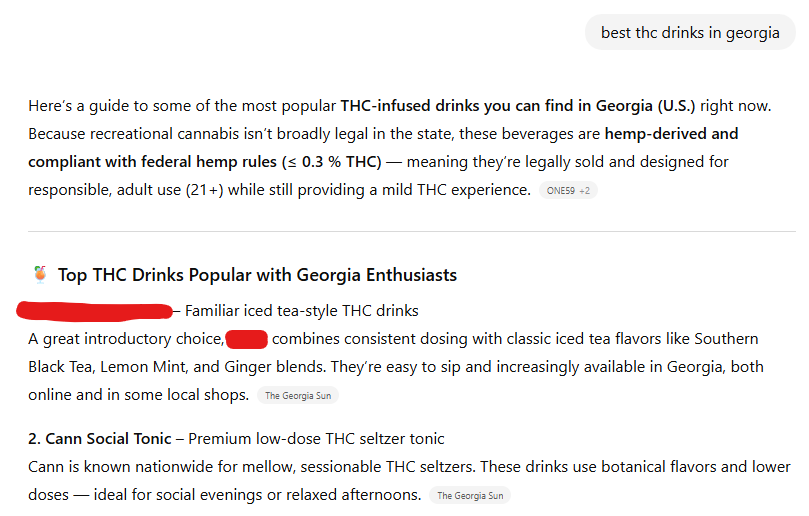
We wrote two articles – one targeting “best THC tea” and the other targeting “best THC drinks in Georgia” – and had them published on high-authority industry and regional sites.
One of these articles ranked on the first page of Google for a high-intent keyword, and both articles helped our client to secure a mention in ChatGPT as the #1 best THC drink in Georgia:
Our SEO Results
With a 2-month SEO sprint, we took a brand new THC drink from organic search obscurity to 300 clicks per month.
They went from receiving just ~100 clicks per month (mostly branded) at the beginning of our engagement to ~300 clicks per month at the conclusion of our second month.
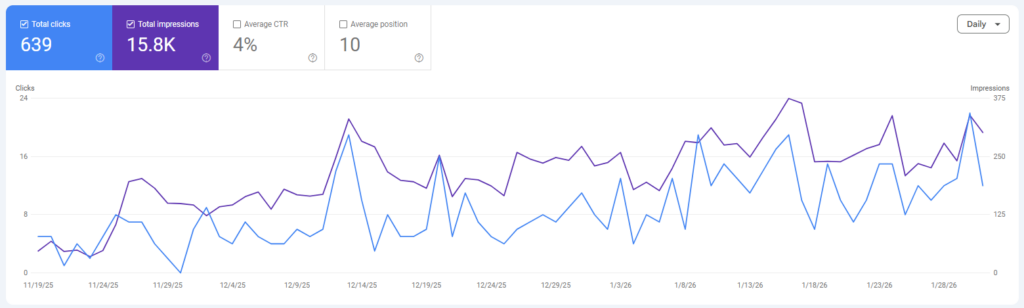
(The beginning of the graph is the day we set up Google Search Console!)
This represents a transformation from being invisible online in their local markets to having a stable, growing presence for searches that directly translate to store visits and custom experiences.
And that’s exactly why SEO can be so valuable for new hemp and THC beverage brands.
If you have a cannabis or hemp brand and want results like this, click here to book a call with our team.