Many cannabis and hemp brands (and their agencies) start their SEO strategy with keyword research instead of customer research.
This usually leads to brands expending resources to create a flood of informational blog posts about legality, effects, and general cannabis education.
While there is certainly no shortage of traffic to be driven from these topics, the people searching these things aren’t ready to buy cannabis or hemp products.
So even if you rank and get the traffic, your brand won’t make any money. Ranks improve, revenue doesn’t, and your brand is left to maintain or clean up a costly investment that will never pay off.
This cannabis SEO case study demonstrates a completely different approach.
In 11 months, we helped a hemp (THCA) brand grow from about $300/mo in organic revenue to over $32,000/mo.
When we started, they had essentially zero online customer acquisition of any kind (let alone organic).
A year later, and they have a thriving multiple-six-figure customer acquisition channel that continues to grow month over month.
We achieved this result by flipping the typical SEO strategy process on it’s head. Instead of keywords-to-customers, we focused on customers first to determine which keywords would actually drive revenue.
This might seem obvious, but it’s all too uncommon in the cannabis SEO space.
Here’s how we did it.
Our Cannabis SEO Strategy
The cannabis SEO landscape is incredibly crowded.
Brands compete aggressively for broad transactional keywords like “THCA flower,” making it difficult for new brands with lower website authority to build visibility for these revenue-driving keywords.
The keywords that brands can compete for – the easier informational queries like “does THCA get you high?” – don’t generate revenue.
Smaller brands get stuck in between.
This is exactly where our client was – they were a brand new business with little revenue or traffic when they came to us.
So we had to do things differently. Instead of starting with keywords, we started with customers.
We call this approach ICP (ideal customer profile) SEO, and it consists of the following steps:
- Identify your ideal customer profile (ICP)
- Identify when you want to get in front of them
- Identify what they’re searching for at each of those moments
- Determine & build the exact page needed to rank for these searches
It seems simple, but a lot of brands don’t do this.
If you start with customers, you’ll find revenue-driving keywords. If you start with keywords, you might not find any revenue-driving customers.
We came up with the following for our client:
| ICP Moment | Keyword Example | Best Page Type |
| People looking to buy THCA products immediately | THCA dabs | Category page |
| People comparing the best products in a category | Best THCA wax | Blog post |
| People comparing brands before making a decision | Lit Farms vs. Lucky Elk | Blog post |
Based on this analysis and our assessment of our client’s current website situation at the beginning of the project, we decide upon the following blend of SEO tactics:
- Technical SEO
- Keyword research
- Category page updates
- Category page development
- Blog content development
- Link building & parasite SEO
Everything pointed back to the same goal: capture revenue-driven searches, not just traffic.
1. Technical SEO
Before we began optimizing and building the pages that our client needed to rank for the keywords their customers were searching for, we fixed the issues limiting their site’s performance.
Their store was built on Shopify, which gave us a solid starting point – Shopify’s e-commerce infrastructure is extremely robust.
Still, there were several key things we fixed:
- Duplicate Product URLs: By default, Shopify generates multiple URLs for the same product when it appears in different collections, which splits ranking signals and creates unnecessary confusion for search engines. We standardized product URLs by removing the collection subfolder from them, then ensured every product’s URL variants were redirected to the canonical (preferred) version without the subfolder.
- Broken Pages: Our clients had removed products without redirecting the product pages, which meant users (and Google’s crawlers) were hitting dead ends and valuable link equity was being lost. We audited these pages and redirected them to the most relevant destinations.
- Content Removal: Our client had roughly 40 AI-generated and poorly written blog posts. We unpublished and redirected all of them. These pages weren’t ranking, weren’t driving traffic, and weren’t helping the site. More importantly, they were consuming crawl budget that could be better spent on pages that actually matter. Removing them allowed Google to crawl priority pages more often.
- Internal Linking & Navigation: Some menu links pointed to filtered URLs instead of core category pages, which diluted authority signals. We corrected this so authority flowed directly to the pages responsible for generating revenue. We also added more of their categories to their menu so Google knew they were priority parts of the site.
We spent a week – not a month – on this step.
Technical SEO is important, but most of the important fixes can be implemented quickly.
Many agencies spend 1 month or more on technical SEO. All this does is burn your budget and delay the execution of revenue-driving activities: developing content and building authority.
2. Keyword Research
Next, we conducted thorough keyword research to identify every keyword relevant to our client.
But instead of slapping our client’s main product (THCA) into an SEO tool and sorting all the keywords by volume, we used a guided method based on the ICP SEO research we discussed earlier.
You’ll recall we were targeting three key “ICP moments”:
| ICP Moment |
| People looking to buy THCA products immediately |
| People comparing the best products in a category |
| People comparing brands before making a decision |
For users ready to buy, we targeted product category keywords like:
- THCA flower
- THCA wax
- THCA crumble
- THCA hash
These are high-intent searches where the user already knows what they want – they’re just looking for a place to buy it.
For users comparing the best products in a category, we targeted “best” queries like:
- Best THCA vapes
- Best THCA dabs
- Best THCA concentrates
These searches still indicate strong buying intent, but the user needs help deciding which option to choose. Showing up for these searches gave our client an opportunity to guide these potential customers toward their products.
For users comparing brands, we targeted queries like:
- Lit Farms vs. JK Distro
- Arete Hemp vs. Lucky Elk
- Crysp vs. Simply Mary
These happen at the final stage of the buying process, when someone is about to make a decision between two choices.
But by making our client visible for these queries, we stand the chance of convincing readers to add a third option to their pool of brands to consider.
As you can see, there’s quite a bit of thinking that goes into our keyword research process.
We needed to identify which keywords to target with existing content, as well as reveal the gaps in our client’s site structure where they didn’t yet have pages aligned with how people actually search.
We spent roughly 1 week on the strategy. This work is necessary – all too often, we see cannabis and hemp brands struggle when they treat SEO like a technical checklist instead of the marketing channel that it is.
3. Category Page Updates
Now, it was time to begin developing content. First, we targeted our client’s core transactional keywords. But before creating new product category pages for our client, we improved the ones they already had.
Our client had about 20 category pages, but most weren’t fully aligned with search intent – they targeted the wrong keyword for the products in them, and the content present wasn’t adequate from a user experience or SEO standpoint.
So, we mapped every page to a primary keyword and rebuilt it for relevance and depth:
- We rewrote meta titles and descriptions to better target those keywords and improve click-through rates.
- We expanded on-page content so the pages provided enough context for search engines while still being useful for customers (~500-1,000 words).
- We added FAQ sections to capture long-tail searches and address common questions.
Many hemp brands either build dozens of pages with no content (so they lack context), or they overload them with generic content (so Google doesn’t know if the page is transactional or informational). The goal here was balance – enough depth to rank, but focused enough to convert.
4. New Category Page Development
Next, we targeted more transactional keywords by expanding our client’s category structure.
Much of this expansion was focused on building many specific categories for a broad category of products our client sold.
For example, they had a broad “THCA concentrates” page, so we created separate pages for the different concentrate types like:
- THCA wax
- THCA crumble
- THCA diamonds
People (and Google) prefer pages – user experiences – that are hyper-specific to what they’re searching for. A single concentrates category cannot rank for every concentrate search, but a page group can.
Now we were competing on relevance instead of authority.
We also introduced pages targeting bulk and quantity-based searches, which are common among more experienced THCA consumers and businesspeople.
In this instance and others, our client was able to become visible to entirely new market segments without needing to introduce new products.
This expansion ultimately increased the number of transactional keywords our client ranked for – and therefore the amount of money they made.
5. Blog Content Development
Now, it was time to write blog posts.
But instead of targeting informational keywords that wouldn’t drive any new business for our client, we focused on comparison and buyer-intent content targeting two main types of keywords, according to our ICP research:
| ICP Moment | Keyword Format | Example |
| People comparing the best products in a category | Best [PRODUCT] | Best THCA Vapes |
| People comparing brands before making a decision | BRAND vs. BRAND vs. OUR CLIENT’S BRAND | Lit Farms vs. Lucky Elk vs. OUR CLIENT |
We produced roughly two dozen blog posts across these two types, and we threw in a few informational pieces, too, to support key categories.
These pages drove additional sales while also increasing our client’s topical authority, allowing our category pages (the big time money makers) to rank better.
For most cannabis and hemp brands, blog content is an expensive boat anchor. We made it an asset for our client by focusing on customers over keywords.
6. Link Building & Parasite SEO
A good content strategy will open new revenue opportunities, but ultimately, the brands with the most authority have an in-built advantage.
We developed our client’s content structure first to help them begin to grow, but after a couple of months, we began building their authority to set them up for long-term dominance.
We implemented a steady link-building strategy, averaging four to five links per month. Most of these links pointed to the homepage to strengthen overall domain authority, while a smaller portion supported key category pages.
Later, we also began a parasite SEO campaign. Parasite SEO involves publishing optimized list-style articles (listicles) on high-authority websites and linking back to your site.
We created several of these placements for our clients each month, targeting keywords like “best THCA products” and “best THCA flower brands,” allowing them to rank quickly on domains that already had strong authority.
This boosted:
- Visibility / referral traffic from key terms
- Domain authority
- AI mentions
In a competitive space like cannabis, it’s difficult for newer brands to compete head-on for high-value keywords. Parasite SEO allows you to bypass some of that friction, get in front of buyers faster, and reinforce your presence across the search results.
In 2026, it’s simply not enough just to rank your website. You’ve got to rank other people’s, too.
Our SEO Results
Over the first 11 months of our engagement, our client’s organic revenue grew from approximately $300/month to over $32,000/month.
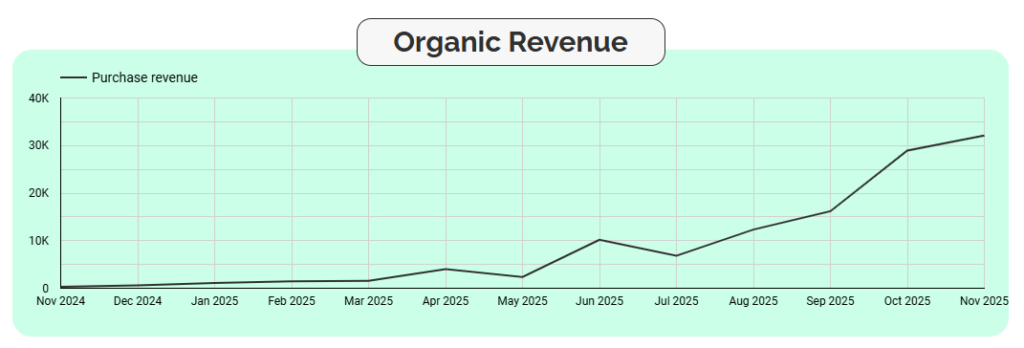
During that time period, organic traffic grew from 325 sessions per month to 12,755 sessions per month.
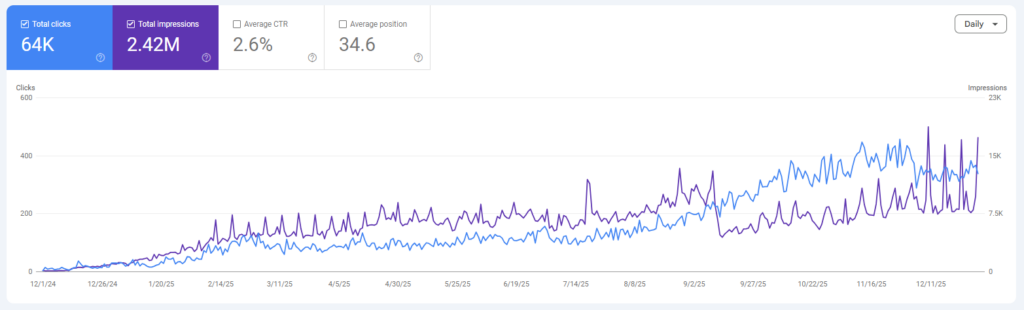
Both figures continue to trend upward and we’re hitting all-time highs in both revenue and traffic as we publish this article in March of 2026.
They achieved #1 rankings for high-intent keywords like “THCA crumble” and “THCA hash,” along with top positions for terms like “THCA dabs” and “THCA wax” and dozens of other valuable terms.
These rankings allow our client to acquire customers consistently while showing up alongside much larger competitors.
The result of our work is a business that now generates meaningful, predictable sales from organic search, where previously, SEO contributed almost nothing to their overall revenue.
This is what happens when SEO is based on buying behavior instead of search volume.
If you have a cannabis or hemp brand and want results like this, click here to book a call with our team.